Context
A fashion app with a changing catalogue and several customer touchpoints.
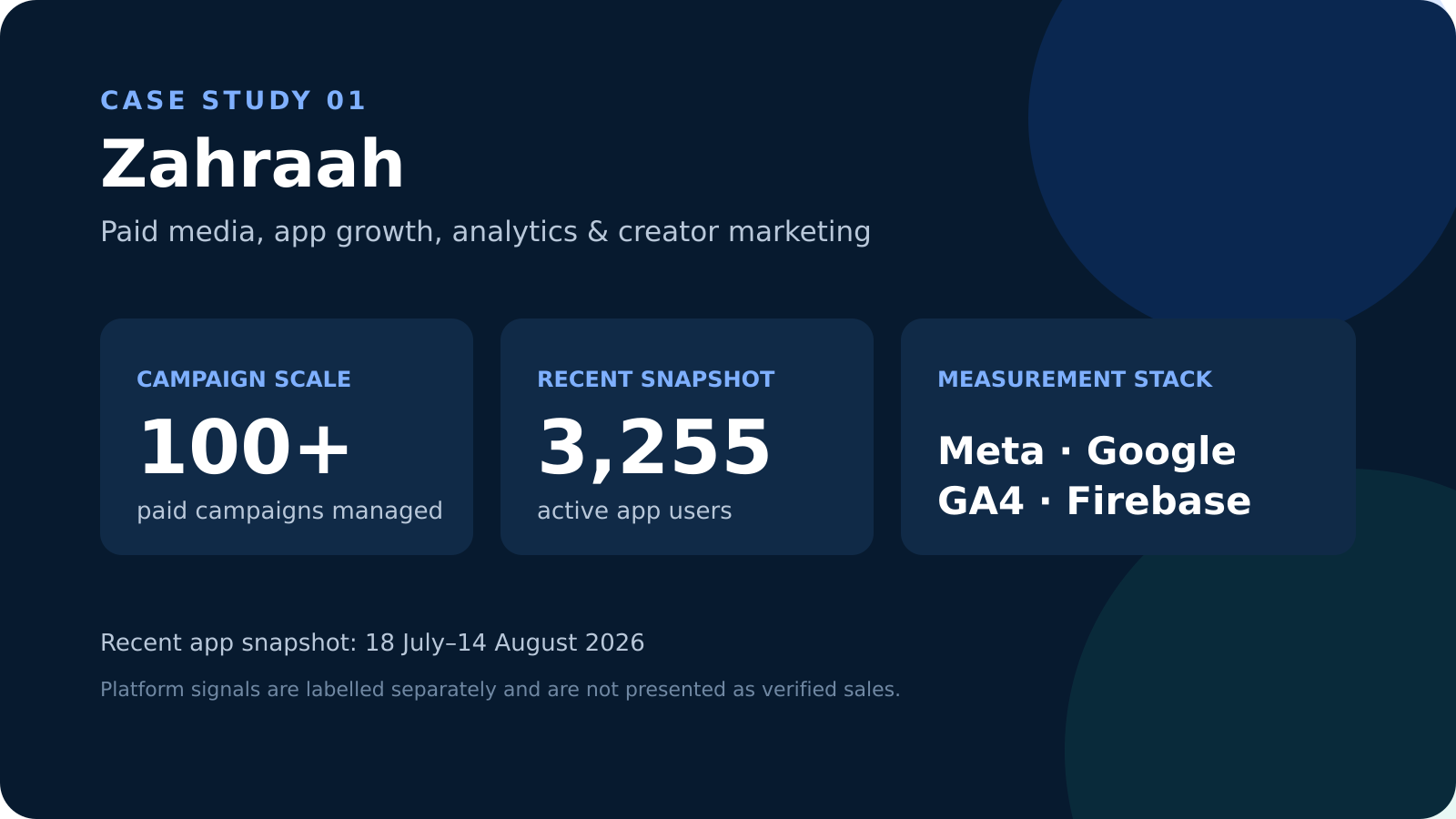
Zahraah serves women shoppers through a mobile application. Marketing supports product discovery, acquisition, re-engagement, content, and cash-on-delivery behavior while the product catalogue changes frequently.
Challenge
Different channels produced different types of evidence.
Meta Ads, Google Ads, GA4, Firebase, organic content, UGC, and creator campaigns each produced useful signals. The challenge was to coordinate execution and read every source according to its own definition without mixing attribution models.
My role
Campaign planning, coordination, analysis, and reporting.
- Planned and optimized paid campaigns across Meta and Google.
- Supported acquisition, engagement, traffic, product discovery, and re-engagement objectives.
- Reviewed GA4 and Firebase behavior, events, sources, and retention signals.
- Coordinated design, photography, content, customer service, management, and technical teams.
- Managed UGC and creator delivery, approvals, publishing, and evidence collection.
- Prepared performance reports and practical recommendations for management.
Execution
A repeatable workflow for campaigns and content.
- Define: Connect the business priority to one audience, objective, and KPI.
- Build: Prepare the campaign structure, creative variants, tracking checks, and delivery plan.
- Operate: Monitor spend, delivery, creative fatigue, and app behavior.
- Compare: Read platform results alongside GA4 and Firebase using each source’s definitions.
- Recommend: Translate the most useful signal and the main limitation into a next action.
Analytics & reporting
Reports were organized around business questions.
AcquisitionWhich channels and campaigns brought qualified traffic efficiently?
BehaviorWhat did users do after the click or install?
RetentionWhere did users return, slow down, or stop?
DecisionWhat should change in the budget, creative, product, or customer journey?
Meta, Google, GA4, and Firebase were treated as connected evidence sources, not as one identical measurement system.